by Heide Brandes
Across America, approximately 22 percent of lost dogs and just 2 percent of lost cats that enter animal shelters are reunited with their families. In Oklahoma City, those already disheartening numbers drop even further.
Here, only 7 percent of all lost pets brought to the municipal shelter are successfully reunited with their owners. For Animal Welfare Superintendent Ronnie Schlabs, these numbers are more than statistics on a spreadsheet. They’re a daily reminder of the heartbreak that could be prevented and the enormous challenge his department confronts.
Of the roughly 20,000 animals that pass through Oklahoma City’s shelter annually, just 10 percent of dogs and a mere 1 percent of cats ever make it back home. For Schlabs, who has spent nearly two decades in animal welfare across multiple states, the city’s low reclaim rates represent one of the most daunting aspects of his new role.
“Our reclaim rate is incredibly low,” says Schlabs. “Some of it is that people don’t think to come down here and look. We do have a very diverse population, and there’s always the potential for language and cultural barriers. The concept of going to the animal shelter just isn’t there for some people.”
The challenges facing Oklahoma City in returning lost pets to their families are as expansive as the city itself. With a vast geographic footprint and a relatively small staff, response times suffer, further complicating recovery efforts. Unlike many cities of similar size, Oklahoma City has no formal pet licensing program, meaning fewer animals wear identifying tags that could help field officers return them directly to their homes.
But perhaps the most significant barrier is simply awareness. Many pet owners don’t realize the municipal shelter exists — or think to check there — when their beloved companion goes missing. Others assume the process will be costly or complicated, leading them to search everywhere except the one place their pet might actually be waiting.
The numbers become even more troubling when compared to national averages. According to the American Veterinary Medical Association, microchipped dogs nationwide return home at a rate of 52 percent while microchipped cats reunite with families 38 percent of the time. For non-microchipped pets, those rates plummet to just 22 percent for dogs and 2 percent for cats. Oklahoma City’s overall 7 percent return rate suggests that identification and education remain critical missing pieces in the reunion puzzle.
“If the animal’s got identification on it, the field officer picks it up and would much rather take it back and drop it off at home than bring it here,” Schlabs says. “There are just so many of them that don’t have that identification on them. We even have a few that sometimes we can’t get a hold of somebody because they’ve moved, or their information with the microchip company is not updated.”
Tightening the Leash on Lost Pets
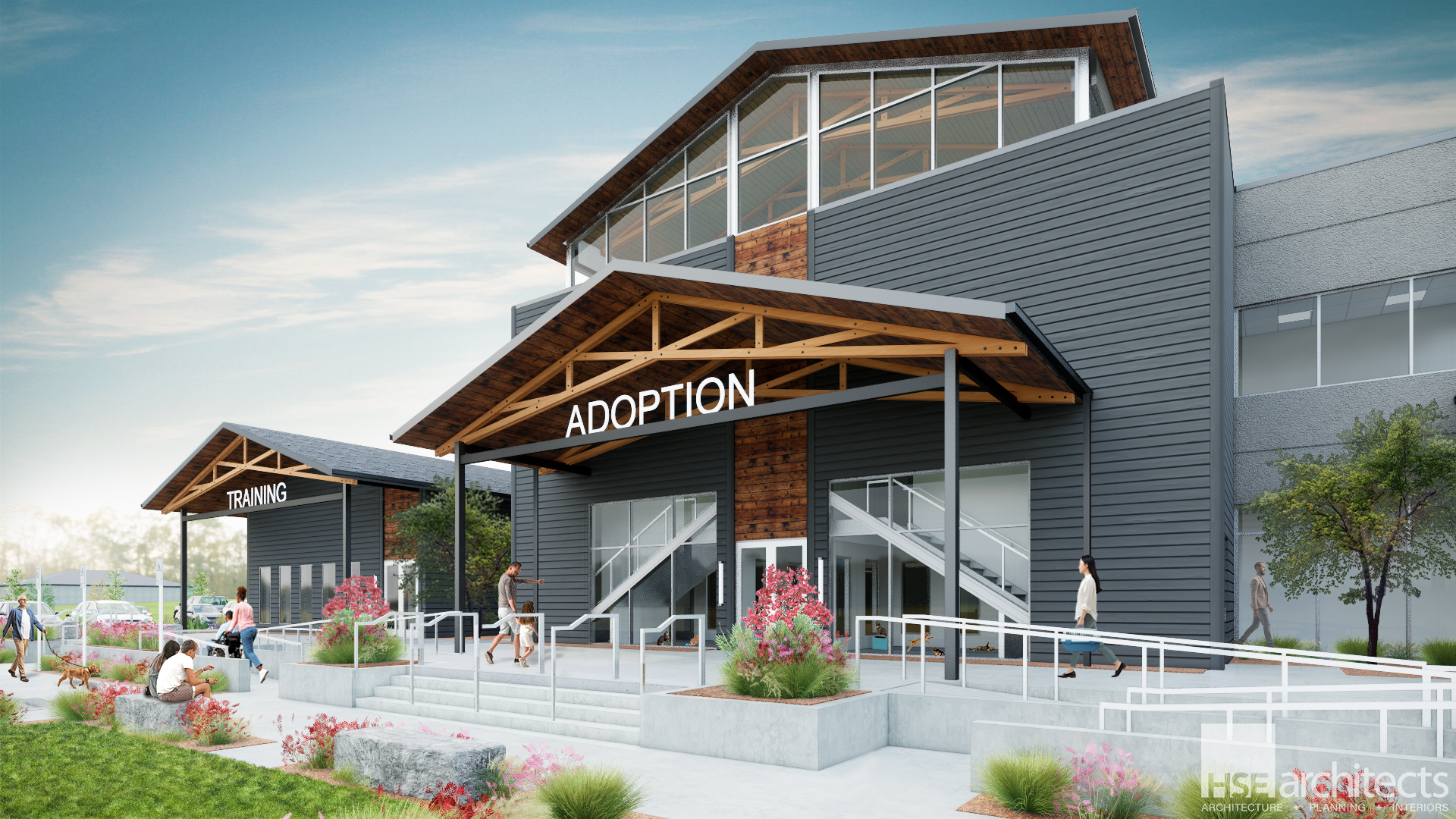
The city is working to improve these outcomes through multiple initiatives. A new state-of-the-art animal welfare facility, currently under construction, will provide significantly more space, enabling expanded programming and community education efforts. The increased capacity means more opportunities to hold events that draw the public in, creating awareness about both the shelter’s services and the importance of proper pet identification.
Schlabs and his team are also developing more robust community outreach efforts. They’ve secured permission to advertise adoption events through Oklahoma City Public Schools and will soon place educational literature in public libraries throughout the city. Most importantly, they’re working to shift the perception of the animal shelter from a place of last resort to a trusted community resource and partner in responsible pet ownership.
“We don’t want to be the first stop for people,” Schlabs says. “If they need to re-home a pet, we should be somebody’s absolute last resort, not only because our resources are limited, but an animal shelter is a stressful environment, especially for an animal that’s been in a home for years.”
The facility maintains a real-time website that updates at least hourly with photos and information about animals currently in their care. It costs nothing to search, and the public can visit during business hours to walk through the kennels, looking for their missing pet.
For families facing financial hardship, staff focus on finding solutions rather than turning them away.
Research shows that microchipped pets are three times more likely to be reunited with their families than those without microchips. Yet according to experts, an estimated 40 percent of microchipped pets are walking around with unregistered chips or outdated contact information, rendering the technology useless when it matters most.
For pet owners, prevention remains the most effective strategy. Schlabs emphasizes that basic confinement prevents most losses.
“The simplest and most basic thing is just don’t let your animal run loose,” he says. “We get complaints all day long about neighbors who let their dog out the front door, and it wanders the neighborhood all day long. That’s very unsafe not only for the animal but also for the community.”
The biological drive to roam compounds the problem, particularly during breeding seasons.
“A male dog can smell a female that’s in season sometimes up to two miles away,” Schlabs says. “Removing that issue and that temptation through spaying and neutering can really help prevent not only animals getting loose but also contribute to fewer animals that we have to find homes for.”
When pets do go missing, immediate action dramatically improves reunion chances. Schlabs recommends posting on social media lost pet pages and putting up flyers in the area where the pet disappeared. Most importantly, he suggests checking the shelter’s website and visiting in person. The majority of successful reunions happen within the
first few days after a pet goes missing.
The new facility represents hope for better outcomes ahead. With more space comes opportunity for expanded programming, better public access and more effective community education. But until the facility opens, Oklahoma City Animal Welfare continues fighting the uphill battle against geography, awareness, and the simple reality that too many beloved pets lack any form of identification.
For now, success is measured one reunion at a time, one family made whole again. As Schlabs and his team work to improve those odds, they’re counting on the community to meet them halfway by taking the simple steps that could mean the difference between a pet lost forever and a happy ending.
Side bar
Getting to Know Ronnie Schlabs
The Man Behind OKC’s Animal Welfare Mission
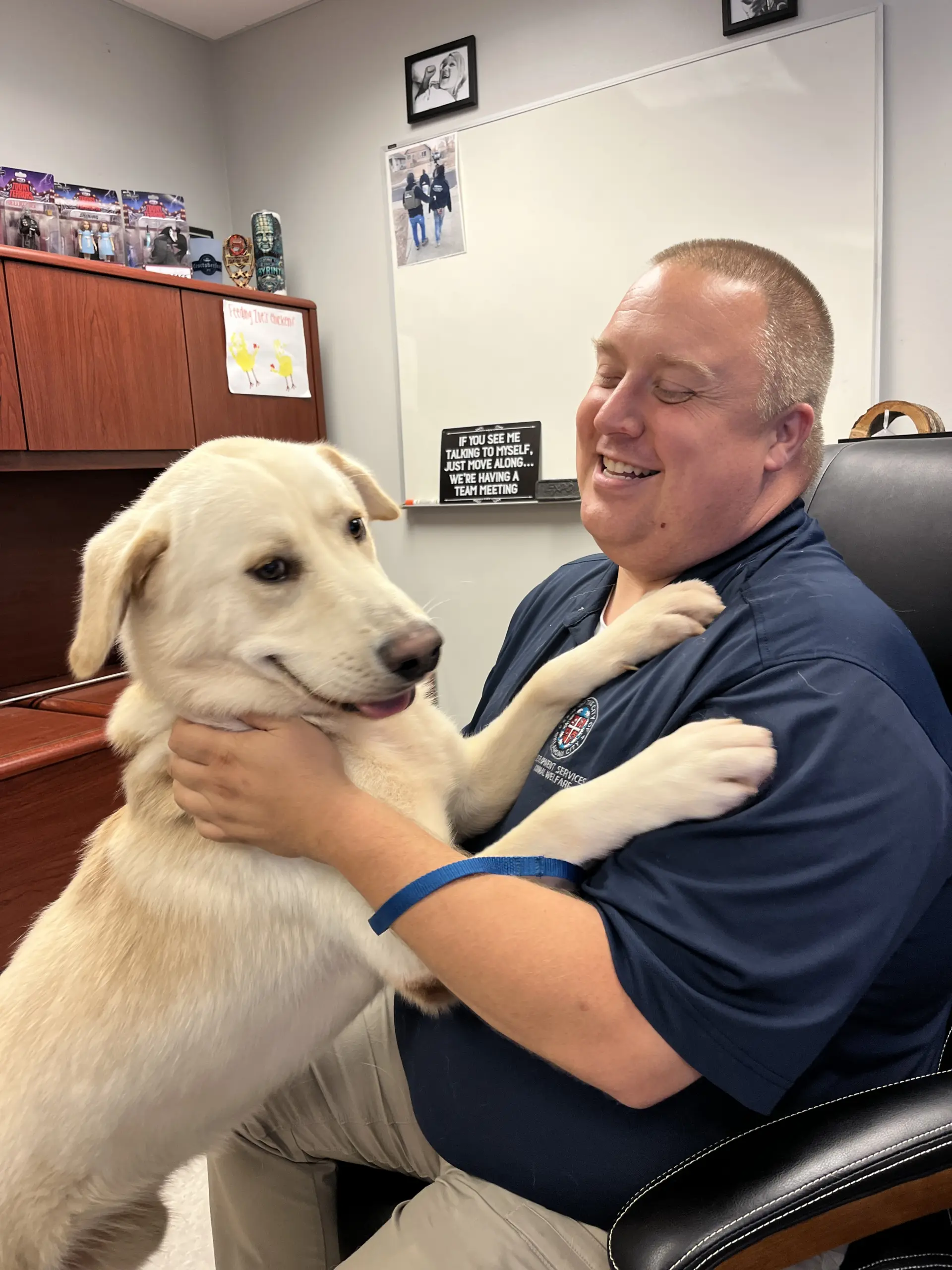
OKC Pets Magazine sat down with Oklahoma City Animal Welfare Superintendent Ronnie Schlabs to learn more about his background and vision for the city’s animal welfare programs.
How did you end up in animal welfare, and what brought you to Oklahoma City?
I started in animal welfare back in 2006, originally planning to use it as a springboard into more traditional law enforcement, but I ended up liking this better and doing it pretty much ever since. I spent several years with the Nebraska Humane Society in Omaha. I was the animal services manager for Hutchinson, Kansas, and the animal control program manager for Cedar Rapids, Iowa. Before coming here, I was the senior director of field operations for the Nebraska Humane Society. I started here March 24 of this year, so I’m still relatively new to Oklahoma City.
What attracted you specifically to the Oklahoma City position?
I’m always looking for ways to grow myself, and I saw this as a good opportunity to advance my career from where I was. My wife and I wanted to stay in this part of the country, so location was a driving force too. Oklahoma City had some interesting and good prospects as far as opportunities for the family. It wasn’t a gigantic city but by no means a small town either. It kind of fit what we were used to living in, since the Omaha metro area and Oklahoma City are about the same size.
You mentioned you originally planned to go into law enforcement but stuck with animal welfare. What keeps you passionate about this work?
As cliché as it sounds, you actually can see and feel like you’re making a difference. I’ve always had an affinity for animals and always loved being around them, so this kind of clicked. At the time, especially when I was still doing a lot of field work, I was doing a lot of law enforcement roles even though I wasn’t a sworn peace officer. But I was still investigating animal crimes. It just kind of resonated with my personality, and I ended up falling in love with it.
What would you say are the most rewarding aspects of your role as superintendent?
Being able to see the direct impact of our work when we successfully reunite a pet with their family or when we place an animal in a loving home. Every life we save, every successful adoption, every animal that gets returned to its owner instead of entering the shelter system, that’s what makes this job worthwhile. We’re not just managing animals; we’re preserving the human-animal bond that means so much to families in our community.
On the flip side, what are the biggest challenges you face in this position?
Having more animals than we have resources for. Capacity is always at a critical state, and it has been since I started here. From what I’ve learned, it’s kind of a historical truth of the operation. We’re always operating typically over capacity, trying to save as many lives as possible, just trying to find ways to make that work. Oklahoma City’s large geographical footprint creates response time challenges with our relatively small staff. The lack of a formal pet licensing program also contributes to identification issues that make reuniting pets with owners much more difficult.
How do you stay motivated when facing such overwhelming challenges?
You have to focus on the individual success stories while working toward systemic change. Every animal we save, every family reunion, every educational interaction that prevents a future problem makes a difference. We’re also working on long-term solutions like the new facility and expanded community outreach programs. Change doesn’t happen overnight, but it does happen when you stay committed to the mission.
What would you want Oklahoma City pet owners to know about your department and the work you do?
We want people to know that we’re here as a resource, not as a place to fear. If your pet is lost, check our website first; it updates in real time. Come down and walk through our kennels during business hours. If you have concerns about being able to afford reclaiming your pet, come talk to us anyway. We’ll see if we can find some way to make it happen.
We’re also working to get our message out through social media, schools and libraries. Most importantly, please spay and neuter your pets, make sure they have some form of identification, and don’t let them run loose. Prevention is always better than having to fix a problem after it happens.
Cutline
Photo courtesy of OKC Animal Welfare.