In Spencer, a small suburb just east of
Oklahoma City, a camel became one of the most notable and recognizable local celebrities. Every day, Camalotta would wait by the gates at Precious Pets Ranch, and every day, people would stop by to take pictures and feed her camel treats. Unlike many camels, which can be standoffish, Camalotta enjoyed the company of people.
She was the last of her herd at Precious Pets, and at age 26, she was aging. On June 21, 2022, Camalotta had a sudden heart
attack, and her death has left a melancholy hole of sadness to all those who fell in love with the unlikely Oklahoma animal. “Sometimes processing sadness takes time, and then you realize the sadness belongs to everyone that knew the special being that passed, and we grieve the loss and then celebrate the life,” said Tonni Canaday, a friend of the family and an employee who cared for the exotic animals at Precious Pets. “It’s always amazing to me how much of your heart an animal can take without you noticing. It’s not the size of the animal — it’s the personality.”
And Camalotta had plenty of personality, Canaday said. In addition to stealing Triscuits and becoming the star attraction at events and performances, Camalotta had a peaceful heart and a life of stories.
The Story of a Camel
How the camel came to live in Spencer is a long, winding tale, but it all started with Bob Cowles, owner of Precious Pets Ranch and Precious Pets Cemetery. Cowles, who had an abundance of love for all animals, bought his first camel in the 1990s. After
having attended several exotic auctions with lions, tigers, bears, and camels, Cowles and Canaday drove to Eufaula to visit a ranch owned by a couple who had moved from California. Among other things, this couple raised camels and paint horses.
“I met Bob because he had llamas, and I was the dogcatcher in Spencer and became the animal-control officer. I had moved from California, and I had exotics too like cougars and lions,” Canaday said. “Bob found out that I had grown up in 4-H and had shown
everything from pigs to sheep and went to Washington, D.C. So being a very community-minded person, he had heard my husband was going overseas to the Azores, and he offered to let me live on the back of the llama ranch if I would show llamas for him.”
In 1994, llamas were selling for $50,000 to $100,000 as part of the “exotics livestock” market that included ostriches and emus. Canaday agreed and moved to the ranch with her young daughter, Kylie. Not long afterward, Cowles decided he wanted a camel.
“He had seen people with camels at the sales. He had met the couple [from California] when we were at one of the Shawnee livestock sales, and they were just amazing people in themselves, very exotic themselves,” Canaday said. “And they talked him into buying this camel.”
Canaday didn’t know anything about showing camels, but she had grown up showing and training horses and cows and pigs and everything in between. Her daughter grew up with llamas and camels and all sorts of other exotics.
“I had to learn all about handling camels. But they were so similar to the llamas in training, so that made it easier,” Canaday said.
The Eufaula ranch was as exotic as the California owners, who wore expensive jeans, flew private airplanes, and dripped in diamonds, but who still happily mucked out stalls. Through a love of travel and aviation, the couple became fast friends with Cowles, who was also a pilot with his own plane. “Bob would only buy the camel after I had climbed the seven-foot pipe fencing to lie across the camel’s soft back, which was covered in a thick carpet of curls. This was not my first or last time on a camel, but like most first times on any large animal, it was exciting and terrifying,” Canaday said.
Although Cowles and Canaday continued to show llamas at livestock shows, the camels were used only in educational exhibits at schools, parades, and even churches for nativity scenes. But life with camels can be an adventure on its own. As the herd of camels grew, Cowles began to sell a few at sales of exotic animals. One day, while hauling one of the camels to the exotic sale at the Oklahoma State Fairgrounds, a board at the bottom of the trailer gave way during rush-hour traffic at Interstate 40 and Robinson.
“With the news choppers swirling around us and the help of a highway patrol officer, I was able to move the camel backwards out of the trailer. Bob repaired the hole in the trailer while I held tight to the lead rope,” Canaday said. “When she calmed down, we put her back inside the trailer safely and continued on our way. This was a camel with very little training and the event on I-40 was an exceptionally stressful feat, but Bob never let that kind of stress bother him. He just calmly proceeded forward doing what needed to be done.”
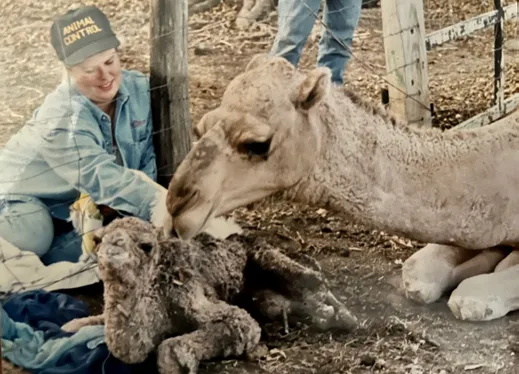
In 1995, Canaday helped to deliver a
baby camel — Camalotta. From her first breath, it became apparent that Camalotta was special.
“She had a personality,” said Canaday. “She came up to people at the gate and just stood there and let them pet her. People would just pull up with their kids and take pictures against the gate. People were good about not going through the gates. They just wanted pictures with her.”
Canaday said Camalotta was a sucker for Triscuits and Wheat Thins, which she discovered through Canaday’s open car window once.
“I left my car window open when shutting a gate, and she grabbed the Triscuits, and like a playful dog, ran off jumping and hopping, thrilled with her capture,” Canaday remembered. “She stood in the creek where I couldn’t reach her and shook the box, dumping them into the water and nibbling them as they floated by.“
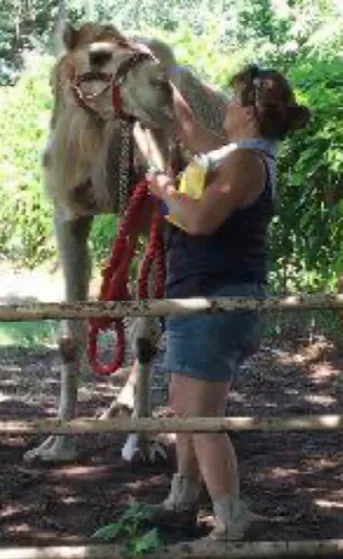
From that point on, whenever the camel saw Canaday’s car or truck, she checked the inside for Triscuits or Wheat Thins. “When I did her yearly medical, I always took her a box of Wheat Thins or Triscuits as her treat,” Canaday said.
“The last drive that Bob and I took through the ranch in October 2020, the leaves were falling, and the flowers lay bare.
Bob and I stopped and shared a box of Triscuits with Camalotta,” Canaday said.
Cowles passed away on February 20, 2021.
Lives Well Lived
Cowles was well known for his love of education and animals and for Precious Pets Ranch and Precious Pets Cemetery, but he was also a hero and a pilot. After graduating from high school, he joined the United States Marine Corps, serving at Hickam Field in Honolulu, Hawaii. He was there during the Japanese attack on Pearl Harbor on December 7, 1941. He remained in Hawaii for another 18 months and was then deployed to fight in the Pacific Theater. He served in Shanghai to protect American citizens during the Chinese Revolution and was always proud of having been a “China Marine.”
In 1986, Cowles and his daughters founded Precious Pets Cemetery near his ranch, and his burial business has since expanded to include four cemeteries.
Cowles lived a life of adventure as an avid pilot. He and his wife, Gloria, saw the world from the sky in their Cessna. Cowles even served as the personal pilot of Governor George Nigh during both of his Oklahoma campaigns.
Cowles’ business and ranch continue, with Canaday, veterinarian Mike Johnson, Cowles’ children, and Gary Egbert, who takes care of the daily ranch and feeding chores.
In her last years, Camalotta’s hump hung sideways because of the rich, healthy food she consumed, but she was happy and healthy.
“In June, we were in the barn, and she was walking behind me. Suddenly her footsteps in the leaves stopped. There was no fear or pain on her face, just a trusting look … there was an immense pause and then stillness,” Canaday said. “It happened so suddenly. She was gone.”
Camalotta was cremated at Precious Pets Cemetery and buried in the Last Corral, joining all the other personal pets and animals that Cowles had owned. Even months later, Canaday and the team feel the loss of both the beloved camel and the extraordinary man who had owned her. “Camalotta will be missed by many, a little more by a few of us. To me, that makes her life purposeful and well lived,” said Canaday